Sleep Well Hub
Sleep Positive Culture Assessment
Understand the Organisational Factors Driving Fatigue and Recovery
Fatigue is rarely caused by one issue.
Working patterns, workload, management practices, workplace culture, sleep knowledge and individual circumstances can all affect how well people recover and perform.
A Sleep Positive Culture Assessment provides a structured way to understand how those factors interact across your organisation.
It helps identify where fatigue and inadequate recovery may be creating avoidable risk, reducing performance or placing additional pressure on your workforce.
The result is a clearer picture of where the issues sit, how developed your current approach is and which practical actions should be prioritised.
A Sleep Positive Culture Assessment seeks to understand the whole picture so that improvement can be embedded rather than treated as a one-off intervention.
Book a Free 15-Minute Workforce Recovery Call
What Is a Sleep Positive Culture Assessment?
A Sleep Positive Culture Assessment is a deeper organisational assessment of the factors that influence sleep, fatigue, recovery and human performance.
It goes beyond individual sleep behaviour.
The Assessment considers how organisational demands, management practices, workforce knowledge, recovery opportunity and individual circumstances interact.
This allows Sleep Well Hub to examine both sides of the equation:
-
what the organisation asks people to do;
-
whether people have the knowledge, opportunity and ability to recover from it.
The purpose is to provide leadership with a practical evidence base for deciding what needs to change.
Why Assess Sleep and Recovery Culture?
Organisations already monitor indicators such as:
-
performance;
-
absence;
-
incidents;
-
near misses;
-
productivity;
-
staff turnover;
-
overtime;
-
employee wellbeing.
The difficulty is that fatigue may be contributing to those outcomes without being recognised as part of the cause.
A Sleep Positive Culture Assessment helps connect the information the organisation already holds with what managers and employees are experiencing.
That can expose risks and barriers that are otherwise difficult to see.
The Risk May Be Hidden in Plain Sight
Organisations can monitor performance, incidents, absence and compliance without recognising the role fatigue and inadequate recovery may be playing.
A Sleep Positive Culture Assessment helps connect the information you already hold with what managers and employees are experiencing, identifying where working practices, culture and recovery may be creating avoidable risk.
Fatigue does not always present itself as someone obviously struggling to stay awake.
It may appear through:
-
reduced concentration;
-
slower decision-making;
-
inconsistent performance;
-
irritability;
-
communication problems;
-
increased errors;
-
reduced resilience;
-
absence;
-
presenteeism;
-
people struggling to sustain particular shifts or workloads.
Understanding those patterns is the first step towards more targeted action.
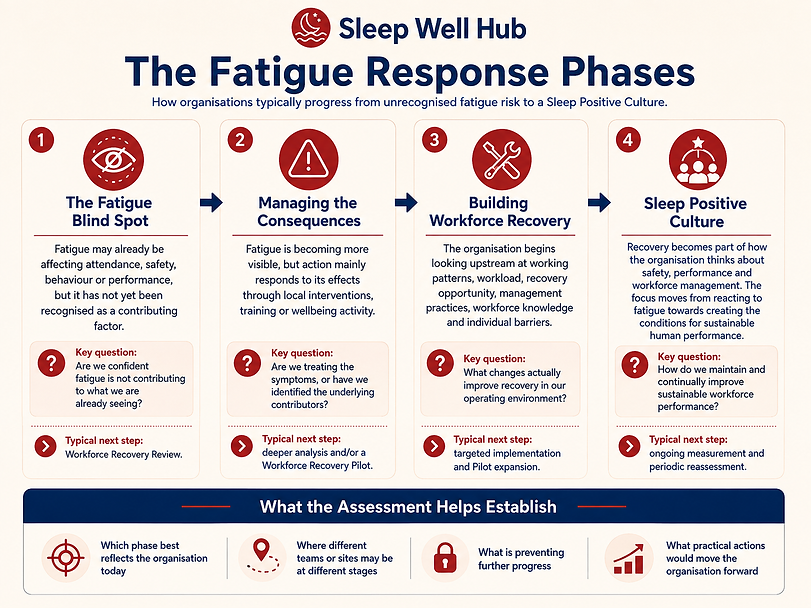
The Four Fatigue Response Phases
Phase 1 — The Fatigue Blind Spot
Fatigue may be present, but it is not yet being recognised as a contributing factor.
The organisation may already be seeing:
-
absence;
-
errors or near misses;
-
inconsistent performance;
-
low resilience;
-
irritability or conflict;
-
overtime pressure;
-
retention problems.
These issues are monitored individually, but the possible connection with fatigue and inadequate recovery has not yet been made.
The leadership question at this stage is:
Are we confident fatigue is not contributing to what we are already seeing?
Typical next step: Workforce Recovery Review.
Phase 2 — Managing the Consequences
Fatigue has become more visible, but action is mainly responding to its effects.
The organisation may introduce:
-
wellbeing initiatives;
-
sleep-awareness training;
-
additional supervision;
-
local changes following incidents;
-
absence-management interventions;
-
reminders about personal responsibility for sleep.
These actions may be useful, but the organisation still has limited understanding of why fatigue is occurring.
The leadership question becomes:
Are we treating the symptoms, or have we identified the underlying contributors?
Typical next step: deeper Business SONA analysis and/or a Workforce Recovery Pilot.
Phase 3 — Building Workforce Recovery
The organisation begins addressing the causes of fatigue rather than only its consequences.
Leadership starts examining:
-
working patterns;
-
workload;
-
staffing;
-
recovery opportunity;
-
fatigue reporting;
-
manager capability;
-
workforce sleep literacy;
-
individual barriers to restorative sleep.
Practical interventions are tested and evidence is gathered.
Managers and employees start sharing responsibility for creating conditions in which effective recovery is possible.
The leadership question becomes:
What changes actually improve recovery in our operating environment?
Typical next step: targeted implementation, Pilot expansion and wider organisational improvement.
Phase 4 — Sleep Positive Culture
Fatigue and recovery are integrated into how the organisation manages people and performance.
Sleep and recovery are considered alongside:
-
safety;
-
workforce planning;
-
shift design;
-
workload;
-
leadership;
-
wellbeing;
-
performance;
-
organisational resilience.
Managers understand fatigue, employees can raise concerns appropriately, individual sleep difficulties can access support, and organisational decisions consider their effect on recovery.
The organisation is no longer waiting for fatigue to become an operational problem before acting.
The leadership question becomes:
How do we maintain and continually improve sustainable workforce performance?
Typical next step: ongoing measurement, improvement and periodic reassessment.
Where Is Your Organisation on the Fatigue Journey?
Organisations rarely move from having no awareness of fatigue directly to having a fully developed Sleep Positive Culture.
Most progress through a series of stages as fatigue becomes more visible, its underlying causes become better understood and recovery becomes more deliberately incorporated into organisational decision-making.
Sleep Well Hub uses four Fatigue Response Phases as a practical way of understanding where an organisation currently sits.
1. The Fatigue Blind Spot
Fatigue may already be affecting safety, attendance, behaviour or performance, but it has not yet been recognised as a contributing factor.
The organisation sees the outcomes without necessarily seeing the connection.
2. Managing the Consequences
Fatigue is becoming more visible and the organisation has started responding.
Training, wellbeing initiatives or local interventions may have been introduced, but activity remains mainly focused on managing the consequences rather than understanding all of the underlying causes.
3. Building Workforce Recovery
The organisation begins looking upstream.
Working patterns, workload, recovery opportunity, management practices, workforce knowledge and individual barriers are examined together.
Practical changes are tested and the organisation starts building evidence about what improves recovery in its own operating environment.
4. Sleep Positive Culture
Recovery becomes part of the way the organisation thinks about safety, performance and workforce management.
Fatigue is understood, managers know how to respond, employees can raise concerns, working practices consider recovery and appropriate individual support is available when required.
The focus moves from reacting to fatigue towards creating the conditions for sustainable human performance.
What Does the Assessment Tell You?
The Sleep Positive Culture Assessment helps establish:
-
which phase best reflects the organisation today;
-
where different teams or sites may be at different stages;
-
what is preventing further progress;
-
which Business SONA factors require attention;
-
what practical actions would move the organisation forward.
It is possible for an organisation to be relatively mature in one area and much less developed in another.
For example, managers may have strong fatigue knowledge while working patterns provide inadequate recovery opportunity.
That is why the Assessment looks beyond a single score.
The objective is to understand where the gaps are and what should happen next.
What Does the Assessment Examine?
The Assessment uses Business SONA to examine four connected areas that influence workforce fatigue and recovery.
Sleep Literacy
What managers and employees understand about sleep, fatigue and recovery.
This may include:
-
recognising possible signs of fatigue;
-
understanding circadian rhythms and sleep debt;
-
caffeine and alertness;
-
manager confidence in discussing fatigue;
-
common myths and misunderstandings;
-
understanding how fatigue affects safety and performance.
Opportunity
Whether working patterns, workload and workplace practices provide a realistic opportunity for people to recover.
This may include:
-
shift patterns;
-
working hours;
-
overtime;
-
rest periods;
-
workload;
-
staffing pressures;
-
commuting;
-
breaks;
-
recovery between duties;
-
workplace expectations.
Need
How biological differences, accumulated demands and the nature of the work affect recovery requirements.
This may include:
-
chronotype;
-
age-related differences;
-
accumulated sleep debt;
-
physical workload;
-
cognitive workload;
-
changing recovery needs;
-
individual vulnerability to fatigue.
Ability
Whether people are able to obtain restorative sleep and recovery when the opportunity exists.
This may include:
-
stress;
-
hyperarousal;
-
persistent sleep difficulties;
-
the Sleep Effort Trap;
-
unsuitable sleep environments;
-
habits that interfere with recovery;
-
health-related barriers;
-
access to appropriate individual support.
Business SONA helps distinguish between a lack of knowledge, insufficient recovery opportunity, increased recovery need and an inability to sleep effectively.
That distinction matters because each problem requires a different response.
What Is Included in the Assessment?
The scope is agreed before the project begins and is adapted to the size, structure and complexity of the organisation.
The Assessment may include:
-
leadership discovery meetings;
-
workforce questionnaires;
-
interviews with managers and employees;
-
review of relevant policies and procedures;
-
review of working patterns and shift arrangements;
-
assessment of fatigue reporting;
-
review of management practices;
-
identification of organisational and individual barriers;
-
analysis through Business SONA;
-
prioritised findings;
-
leadership presentation;
-
practical improvement roadmap.
The objective is to understand the organisation sufficiently well to identify where action will have the greatest value.
Leadership and Workforce Perspectives
Managers and employees often experience different parts of the same system.
Leadership may see:
-
absence;
-
overtime;
-
performance;
-
incidents;
-
productivity;
-
staffing pressures.
Employees may experience:
-
difficulty recovering between shifts;
-
persistent tiredness;
-
problems sleeping;
-
long commuting times;
-
workload pressures;
-
caring responsibilities;
-
reluctance to report fatigue.
Both perspectives are important.
The Assessment brings them together to identify where apparent individual problems may have organisational contributors and where organisational changes alone may not be enough.
What Will You Receive?
The Sleep Positive Culture Assessment provides:
-
a structured picture of current fatigue and recovery pressures;
-
analysis using Business SONA;
-
identification of organisational and individual barriers;
-
evidence to support leadership decisions;
-
immediate priorities;
-
longer-term priorities;
-
practical recommendations;
-
an improvement roadmap;
-
a basis for monitoring progress.
The aim is to make the findings usable.
The Assessment should help leadership decide:
What should we change first, why does it matter and how will we know whether it has helped?
From Assessment to Action
The Assessment is designed to lead to proportionate action.
Recommendations may involve:
Working Practices
Changes to working patterns, workload, recovery opportunity or local operating practices.
Management Capability
Improving manager understanding, recognition and conversations around fatigue.
Workforce Education
Targeted sleep, fatigue and recovery training.
Reporting and Culture
Improving how fatigue is recognised, discussed and reported.
Individual Support
Confidential sleep support where employees or leaders have sufficient opportunity to recover but continue to experience persistent sleep difficulties.
Monitoring
Using appropriate operational and workforce indicators to assess whether changes are working.
A Proportionate Approach
Different organisations require different levels of intervention.
The purpose of the Assessment is to understand the situation well enough to recommend action that matches the level and nature of the problem.
Some organisations may identify a small number of specific improvements.
Others may need broader changes across working practices, leadership, training or culture.
Where persistent individual sleep difficulties are identified, targeted confidential support can sit alongside organisational action.
Who Is the Assessment For?
The Sleep Positive Culture Assessment is particularly relevant to organisations experiencing:
-
shift work;
-
night work;
-
early starts;
-
long or irregular hours;
-
high overtime;
-
safety-critical activity;
-
operationally demanding work;
-
fatigue-related errors or near misses;
-
absence or presenteeism;
-
burnout;
-
poor morale;
-
reduced resilience;
-
retention difficulties;
-
concerns about workload and recovery;
-
uncertainty about the scale or causes of fatigue.
It is particularly useful where leaders recognise that fatigue may be an issue but want a structured way to understand the whole organisational picture.
Sectors We Support
Sleep Well Hub works particularly well with organisations operating in environments where fatigue can affect safety, reliability and performance, including:
-
transport and logistics;
-
haulage and fleet operations;
-
rail contractors and supply-chain businesses;
-
manufacturing and engineering;
-
infrastructure and utilities;
-
warehousing and distribution;
-
energy and offshore-wind supply chains.
These organisations often face genuine fatigue exposure without having a dedicated internal fatigue specialist.
How Is This Different From a Workforce Recovery Review?
A Workforce Recovery Review is the focused diagnostic entry point.
It helps identify where fatigue and inadequate recovery may be affecting the organisation and which issues deserve attention.
A Sleep Positive Culture Assessment goes deeper.
It examines the wider organisational system, including culture, policies, working practices, management capability, workforce experience and access to support.
A simple distinction is:
Workforce Recovery Review = Where is the problem?
Sleep Positive Culture Assessment = How developed is our organisational approach, and what needs to change?
This distinction is important because the Assessment should feel like a more developed organisational intervention rather than simply a larger version of the Review.
How Is This Different From a Workforce Recovery Pilot?
A Workforce Recovery Pilot tests practical interventions in a defined team, site or operational area.
The Sleep Positive Culture Assessment examines the broader organisational environment.
A Pilot helps answer:
What works here?
The Assessment helps answer:
What does the organisation need to change more systematically?
Indicative Investment
Sleep Positive Culture Assessments start from: £5,950
Final pricing depends on factors including:
-
workforce size;
-
number of sites;
-
range of working patterns;
-
number of interviews;
-
survey requirements;
-
depth of policy review;
-
rota and working-pattern analysis;
-
reporting requirements;
-
organisational complexity.
Travel and accommodation are quoted separately where required.
Why Sleep Well Hub?
Sleep Well Hub is led by Mark Phillips, who brings more than 45 years' experience across the Army, policing and safety-critical industries.
His experience includes work involving sleep, fatigue management, human performance and Non-Technical Skills across sectors including rail, road transport and offshore wind.
That operational background shapes the way the Assessment is conducted.
The focus is on understanding how organisational demands and human recovery interact in real working environments.
Frequently Asked Questions
What is a sleep-positive workplace culture?
A sleep-positive workplace culture recognises that fatigue and recovery can affect safety, health and performance and considers those factors when designing work, managing people and supporting employees.
Is the Assessment only for shift workers?
No.
Shift work can increase fatigue exposure, but long hours, workload, commuting, stress and persistent sleep difficulties can also affect employees working conventional schedules.
Does the Assessment involve employees?
Usually, yes.
Workforce experience provides important information about how working practices affect recovery in reality.
Will you review our shift patterns?
Working patterns may form part of the Assessment where they are relevant to the fatigue issues being investigated.
Does the Assessment include training?
Training may be recommended or incorporated where knowledge and manager capability are identified as priorities.
Does it include individual sleep support?
Individual support can be added where persistent sleep difficulties are identified and confidential intervention is appropriate.
What happens after the Assessment?
You receive prioritised findings and recommendations designed to support practical action.
Sleep Well Hub can then provide implementation support, training, targeted interventions or further monitoring where required.
What Happens Next?
The first step is a free 15-minute Workforce Recovery Call.
We will discuss:
-
the issues you are seeing;
-
which parts of the workforce appear most affected;
-
the working patterns involved;
-
what evidence is already available;
-
what action has already been taken;
-
whether a Sleep Positive Culture Assessment is the appropriate next step.
Book a Free 15-Minute Workforce Recovery Call