Sleep Well Hub
Fit for Work — But Fit for Which Working Week? Lessons from the London Bridge Fatigue Incident
What the London Bridge buffer stop collision tells us about fatigue, medical fitness and organisational crossover risk
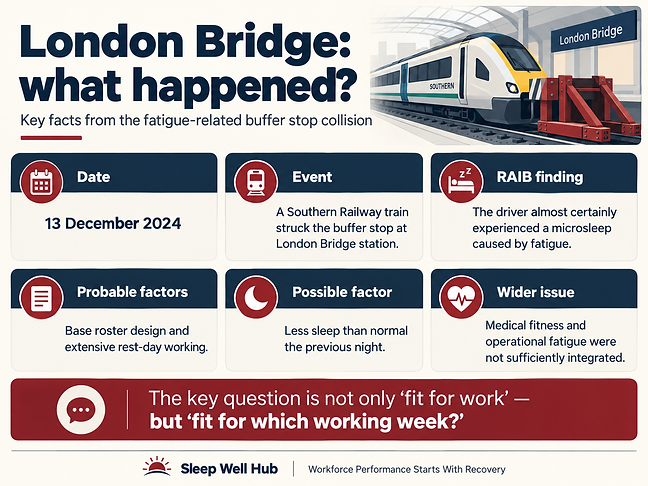
On 13 December 2024, a Southern Railway passenger train struck the buffer stop at London Bridge Station.
The collision happened at low speed. There were no reported injuries and only minor damage.
But the subsequent Rail Accident Investigation Branch (RAIB) investigation exposed something much more significant than the physical consequences of the accident.
RAIB concluded that the driver almost certainly experienced a microsleep caused by fatigue.
The investigation identified the design of the driver's base roster and the amount of rest-day working undertaken before the accident as probable causal factors.
Having less sleep than normal the night before the accident was identified as a possible causal factor.
There was, however, another finding which deserves particular attention.
It concerns what can happen when medical fitness and operational fatigue are considered separately rather than as parts of the same risk picture.
That is the subject of this case study.
The obvious story is not necessarily the right one.
At the time of the accident, the driver was taking prescription medication for a medical condition.
It would therefore be very easy to construct a simple narrative:
Medical condition + medication + microsleep = medication contributed to the accident.
But that is not what RAIB found.
The driver had declared the condition and medication to their employer.
Govia (now Greater )Thameslink Railway's occupational health department obtained external medical advice and acted on it.
The driver was assessed as fit to work.
Crucially, RAIB found no evidence that either the medical condition or the medication contributed to the accident.
The more useful learning lies elsewhere.
What was the driver actually "working"?
RAIB examined the driver's working pattern before the accident.
In the 22 days preceding it, the driver had been rostered for 12 rest days.
They worked nine of them. That left three actual rest days during the 22-day period.
Looking across the preceding three months, the driver had taken only ten rest days — an average of fewer than one per week.
RAIB also identified six recognised fatiguing factors in the roster during the month before the accident, including early and very early starts, insufficient days off following blocks of early starts, more than 12 consecutive day shifts, more than 55 hours worked in seven days and substantial variation in successive shift start times.
This changes the question. It is no longer simply:
Was this person medically fit to work?
A better question becomes:
Fit to work under what working conditions?
A gap between two perfectly reasonable processes.
This is where the case becomes particularly valuable from a Human Factors perspective.
The external medical consultant who advised on the driver's fitness understood the driver to be working something resembling a normal working week without significant overtime or rest-day working.
The consultant believed that any additional fatigue risk resulting from extra hours would be managed by the employer's occupational health arrangements.
RAIB found that this additional risk was not explicitly considered by occupational health or by other line managers.
No single statement there necessarily indicates somebody deliberately ignoring a known danger.
Instead, it illustrates what I believe is a familiar organisational problem.
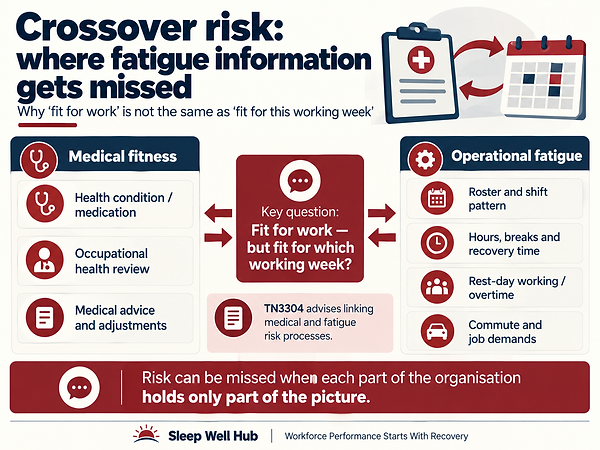
Different parts of an organisation can each hold part of the information required to understand a risk, while currently nobody brings those pieces together.
Occupational health may understand the person's medical condition.
Operations may understand the roster.
Resource management may understand overtime and rest-day availability.
The employee understands how they actually feel.
HR may understand adjustments, absence and employment implications.
Each perspective may be reasonable in isolation.
The risk exists in the space between them.
RSSB now calls this “Crossover Risk”.
Following RAIB's investigation, Recommendation 2 asked the Rail Safety and Standards Board (RSSB) to review industry guidance on additional working hours for employees with medical conditions.
In September 2026, RSSB issued Technical Note TN3304: Crossover Health and Safety Fatigue Risks.
Its purpose is explicit.
RSSB says the London Bridge investigation found that the driver's actual working hours had not been considered when fitness for safety-critical work was assessed and that medical and operational fatigue risk management had not been sufficiently integrated.
TN3304 Issue 1
The important idea is the crossover.
RSSB advises organisations to link medical and operational fatigue processes using clear triggers running in both directions.
A medical issue should prompt consideration of operational fatigue risk.
An operational fatigue concern should also prompt consideration of whether there may be a medical or health factor involved.
That is a very different approach from treating medical fitness and fatigue management as independent systems.
Give the clinician the reality of the job.
TN3304 also provides practical guidance on the information that may be useful when an organisation seeks medical advice.
Rather than simply giving a job title, RSSB recommends providing a picture of how the person actually works.
That can include:
-
typical shifts and the base roster;
-
actual hours, breaks and variations;
-
commuting and overnight stays that increase time away from home;
-
likelihood of overtime, extended hours or rest-day working;
-
the physical and cognitive demands of the job.
That distinction matters. “Train driver” describes an occupation.
It does not tell a medical professional whether someone is working early starts, rotating duties, substantial overtime, repeated rest day working, long commutes or additional hours on top of their base roster.
Those details can materially alter the fatigue exposure being assessed.
Fatigue is both an individual and a system risk
There is an important balance here.
Individuals retain responsibility for assessing how they feel, managing their rest and reporting concerns about their ability to work safely.
RAIB explicitly reinforced those responsibilities in its learning from the accident.
But individual responsibility is not an organisational control system.
RAIB found that before allocating rest-day work, resource managers checked compliance with working-hour limits but did not assess whether the additional work increased fatigue risk for the individual concerned.
The company's process placed substantial responsibility on employees to self-manage fatigue when choosing rest-day working.
RAIB observed that employees may not always be best placed to make that assessment objectively, particularly where additional earnings are involved.
TN3304 reinforces the wider principle by referring to ORR guidance that fatigue should be treated as both a system risk and an individual risk.
Those two responsibilities coexist.
The organisational lesson:
look for the interfaces, At Sleep Well Hub, this is where I think the case becomes particularly useful.
The learning is not simply that excessive hours can cause fatigue. We already know that.
The deeper question is:
Where can important fatigue information become disconnected as it moves through an organisation?
For example, an organisation might have a medical fitness procedure, an occupational health provider, a fatigue policy, a compliant roster, overtime controls and a reporting system.
Individually, each may appear satisfactory.
But what happens when someone's medical circumstances change?
Does that trigger reconsideration of their actual working pattern?
If overtime increases?
If they repeatedly work rest days?
If their commute changes?
If a manager notices increased sleepiness?
Does that information cross organisational boundaries, or does each function continue operating within its own process?
That is where work as imagined can diverge from work as actually done.
And it is precisely where apparently small gaps can combine.
What would a recovery-focused review examine?
Using the Sleep Well Hub Business SONA framework, the London Bridge case raises questions across several interacting areas.
Sleep Literacy: Do employees and managers understand cumulative fatigue, rest-day working and the difference between being legally permitted to work and being sufficiently recovered to work safely?
Opportunity to Recover: Does the actual pattern of work provide adequate opportunity for recovery once additional hours, rest-day working, commuting and variations from the base roster are included?
Need for Recovery: Are individual circumstances, health factors and the demands of the role being considered alongside the working pattern rather than separately?
Ability to Recover: Are there factors which mean that time away from work does not necessarily translate into effective recovery?
Business SONA is not a replacement for an FRMS, occupational health assessment or medical judgement.
Its purpose is different: to help identify where the conditions affecting recovery interact and where further investigation or control may be needed.
Control the source where you can
TN3304 does not stop at identifying the problem.
It gives examples of organisational responses where somebody's working conditions may increase fatigue risk.
These include changing rotating shifts to more stable patterns, reducing hours, preventing additional or rest-day working and adding rest days to the employee's pattern.
That matters because fatigue management should not begin and end with telling employees how to sleep better.
Sleep education has a place. So does individual responsibility. But where the source of fatigue exposure sits in roster design, additional hours, workload or organisational processes, the organisation also has the ability to remove or reduce that exposure at source.
The question this case leaves us with
The London Bridge accident involved one driver, one train and one set of circumstances.
The organisational question is much wider.
Could your organisation have people who are technically “fit for work”, while nobody has considered whether they are fit for the work pattern they are actually doing?
And if the relevant information currently sits across HR, occupational health, operations, rostering, safety and the employee themselves:
Who joins it together?
That may be the most important lesson from this incident.
About this case study
This is an independent Sleep Well Hub analysis of publicly available safety information.
Sleep Well Hub was not involved in the incident, investigation or organisations concerned.
The principal sources are Rail Accident Investigation Branch Report 09/2025, Buffer stop collision at London Bridge station, and Rail Safety and Standards Board Technical Note TN3304 Issue 1, Crossover Health and Safety Fatigue Risks.
TN3304 is a non-binding technical note providing interpretation and guidance; it does not itself create new mandatory requirements.
RSSB states that it will be withdrawn when the revised RS504 Fatigue Management – A Good Practice Guide is published.
Could fatigue risk be hidden between your existing processes?
A Workforce Recovery Review examines how working patterns, recovery opportunity, management practices, workforce circumstances and organisational controls interact in the reality of work.
The aim is not simply to identify tired employees. It is to understand what is creating or increasing the fatigue exposure and where the organisation can act.
Book a free 15-minute Workforce Recovery Call →